

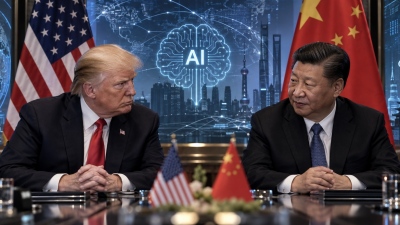
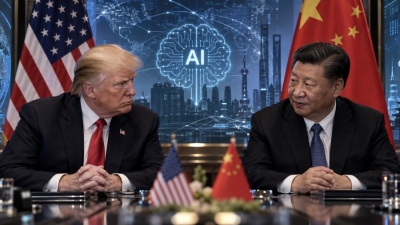
When President of the United States Donald Trump welcomes his Chinese counterpart Xi Jinping to Washington on September 24, on the table will be trade, tariffs, semiconductors, rare earths, Taiwan, and a series of further open fronts between the two largest economic superpowers on the planet. Yet behind all of this now lies an issue that could prove more pivotal than any trade deal: Artificial Intelligence (AI).
Reuters confirms that AI is among the primary topics of the Donald Trump–Xi Jinping discussions, while preparatory contacts between the two sides already encompass the safety of frontier models, open-weight systems, and potential «guardrails» against perilous applications.
The distinction is fundamental.
A tariff can be repealed.
A trade pact can be renegotiated.
A restriction on chip exports can become stricter or looser.
AI, however, is transforming into a foundation upon which industry, scientific research, cybersecurity, robotics, and military applications of the future can simultaneously be constructed.
That is why the Donald Trump–Xi Jinping meeting constitutes, to a significant extent, a summit determining who will shape the subsequent technological era.

The old perception of China collapses
For years, a large portion of the Western discourse surrounding artificial intelligence rested on a relatively straightforward assumption: the United States invents the technology and China strives to close the distance.
Data from 2026 render this assessment far more difficult to sustain.
The Stanford AI Index 2026 records that Chinese and American frontier models have alternated the top position several times since early 2025.
In March 2026, the flagship American model from Anthropic led the top Chinese counterpart by a mere 2.7% on the relevant evaluation benchmark suite.
Stanford University itself notes bluntly that the performance divide between the two countries has virtually closed.
This does not signify that China has secured comprehensive dominance.
The United States continues to develop more frontier models.
In 2025, 59 notable American models were registered against 35 Chinese ones, while the American side preserves an advantage in highest-impact patents as well.
The discrepancy in private venture capital is even more dramatic.
Private investment in AI across the United States reached 285.9 billion dollars in 2025, compared to 12.4 billion dollars in China.
And yet, China has established an alternative paradigm of strength.
Stanford University registers a Chinese lead in the volume of scientific publications, academic citations, and AI patent grants.
Furthermore, there is another arena where the Chinese standing is far more difficult to contest: converting artificial intelligence into physical productive force.

295,000 robots in a single year
True Chinese strength might not reside solely in chatbots.
It may be located in factories.
According to the International Federation of Robotics, China deployed approximately 295,000 industrial robots in 2024 alone. This represented 54% of all new industrial robots installed globally that year.
The cumulative inventory of operational industrial robots operating inside Chinese plants exceeded two million units.
This is much more than an eye-catching metric.
The upcoming phase of AI will likely not concern merely systems producing text, creating artwork, or responding to prompts.
It will involve machines that see, analyze, decide, and execute actions within the physical domain.
There, the colossal Chinese manufacturing footprint assumes distinct relevance.
When AI interfaces with industrial plants, logistics networks, autonomous vehicles, fulfillment centers, and robotics, the country already possessing mass manufacturing infrastructure possesses the capacity to translate progress from software to the physical environment far more rapidly.
This is perhaps the component of the Chinese model most heavily underestimated in Western analysis.
China does not merely need to engineer a model scoring marginally higher by a few percentage points on a benchmark.
It can strive to prevail via the scale of implementation.

Qwen and the Chinese open ecosystem strategy
A secondary advantage exists as well.
While several of the most capable American systems are becoming increasingly proprietary, prominent Chinese research laboratories have aggressively funded open models.
An analysis by the American US-China Economic and Security Review Commission acknowledged in March that this specific strategy permits China to hover close to the technological frontier despite constraints on computational infrastructure.
The Qwen family of models from Alibaba had already generated more than 100,000 derivative models on Hugging Face, constituting, according to the same American commission, the largest such ecosystem on the platform.
Here a potential compounding flywheel takes shape.
More affordable and accessible models yield a broader developer base.
More applications generate greater adoption.
Greater adoption produces deeper empirical feedback and accelerated optimization.
And when this aligns with the largest manufacturing apparatus on earth, AI can migrate rapidly from data facilities to assembly lines.
This represents a divergent approach from that of Silicon Valley.
It is not necessarily superior across every tier, but it is unequivocally perilous now to dismiss it as mere emulation of the American paradigm.
What Xi Jinping seeks
Xi Jinping possesses minimal incentive to accept an arrangement that would «freeze» Chinese progression while the United States preserves its current lead in advanced semiconductors, data facilities, and private capital.
American export controls on advanced technologies have already driven Beijing to place even greater emphasis on domestic technological self-reliance.
Concurrently, China seeks to present itself not merely as an AI developer, but as a nation asserting a voice in formulating universal architecture.
In July, in Shanghai, Xi Jinping unveiled the Chinese vision for an «equitable and fair» framework for global AI governance.
At the same forum, the charter establishing the World Artificial Intelligence Cooperation Organization was executed, featuring 29 nations as founding members and headquartered in Shanghai.
The Chinese government frames the institution as a collaborative framework, particularly for transferring technological capacity toward nations of the Global South.
This constitutes, naturally, the Chinese paradigm rather than an impartial international standard.
Nevertheless, it signals an aspiration reaching far beyond an effort to «have China catch up to the United States».
Beijing intends to participate in drafting the guidelines.

Expansion without «brakes», but with oversight
A notable divergence also exists between the Chinese technological sphere and segments of the American technology landscape.
In the United States, corporate executives and scientists have started urging a deceleration in frontier model deployment owing to the hazard of surrendering human control.
China pursues a separate course.
Beijing is rolling out mandatory safety benchmarks, security evaluations, and protocols for advanced AI agents, without however adopting generalized deceleration of technological progress as an operating premise. Reuters indicates that China is even formulating a mandatory national compliance standard for the safety of AI agents, while simultaneously pursuing their rapid integration into the wider economy.
The philosophy is clear: parallel development and regulation, rather than withholding progress until every theoretical hazard is eradicated.

The dilemma of Donald Trump
Donald Trump confronts a paradox.
On one side, Washington desires to forestall hazardous military, offensive cyber, or autonomous manifestations of AI.
On the other, any constraint that decelerates American firms could be perceived as a geopolitical concession to China.
Donald Trump has already dismissed the premise of a generalized slowdown, contending that the United States must not surrender technological momentum to its primary competitor.
This establishes a classic security dilemma.
Washington fears slowing down because Beijing might accelerate.
Beijing finds no cause to decelerate because Washington might persist.
Thus, even if Donald Trump and Xi Jinping concur on protocols governing specific dangerous use cases, it is difficult to envision either camp abandoning the overarching contest for more powerful architectures, greater compute capacity, expanded robotics, and deeper industrial integration.
The monumental shift: China is no longer merely the «pursuer»
This is perhaps the most salient factor heading into the September 24 summit.
Washington continues to command immense structural leverage in venture capital, compute clusters, and elite tech firms.
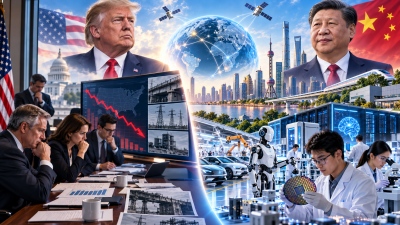
Yet Beijing arrives at the negotiation having drastically narrowed the model performance gap, commanding the largest operational robot fleet in the world, an extensive open AI developer base, and surging ambitions to draft international tech standards.
The American establishment itself now regards Chinese AI not as an abstract future prospect, but as an immediate peer rival. Stanford University discusses a performance disparity that has essentially closed, while official US governmental analyses concede the vitality of the Chinese open-source footprint.
For this reason, the Donald Trump–Xi Jinping summit does not simply revolve around who produces the premier conversational engine.
It centers on which power succeeds in operationalizing AI into industrial output, scientific breakthroughs, commercial fabrication, and tangible geopolitical clout.
In that arena, China holds an advantage that no synthetic benchmark score can fully capture: the capacity to translate technology from research facilities to the factory floor, and from code into industrial mass manufacturing at a velocity and volume that few competitors can match.
The central question of the coming decade, therefore, is not merely whether China can «catch» the United States.
Evidence from 2026 demonstrates that in several pivotal dimensions, the reality has already advanced beyond that framing.
The defining struggle is now which of the two divergent technological systems will prove more adept at transforming artificial intelligence from a remarkable digital capability into the foundational infrastructure of an entire economic order.
www.bankingnews.gr









Σχόλια αναγνωστών